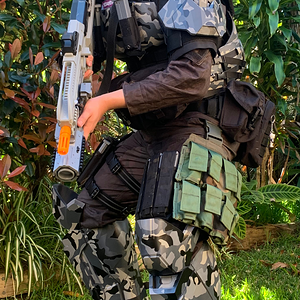
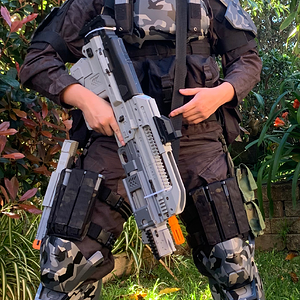
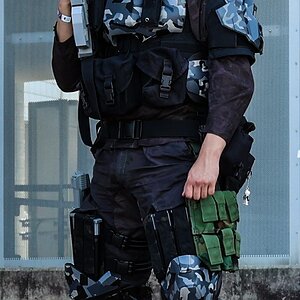
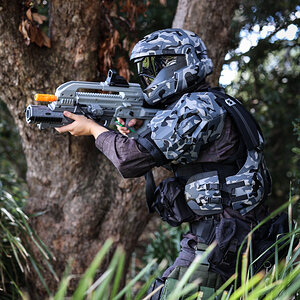
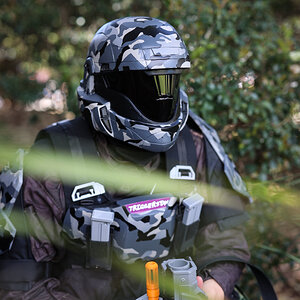
I love the camo work on this. If you don't mind me asking, what was the process for getting it so smooth? I really love how it blends well, and the pattern is pretty consistent!
Hello, thanks for the compliments. I am assuming you're talking about how smooth the surface of the paint is. The smoothness really depends on all the prep work put into making the surface as smooth as possible, like filling in the 3d print lines with a filler mixed with acetone so it's easier to brush on the lines, doing maybe 4 light coats or until the gap in the line is no longer visible, since it shrinks when it dries. Then, sanding it down personally, for my armour, I worked my way up to 1000 grit before even thinking about applying primer. There are tons of tutorials out there as well to help with this. You could search up how to make 3d printed cosplays smooth, for example or have a look around the 405th.
Definitely go look up some videos on how to paint camo onto stuff to get an understanding of how to layer the colours with your preferred camo scheme, print it out, and trace it onto masking/painters tape that's sort of overlapped (the tutorials should cover this).
(For some reason, I can't paste the picture I took for this. Sorry)
After cutting out the stencil with a knife, don’t immediately discard the extra bits that aren’t the pattern itself. I’ve found that those bits are great for adding a bit more randomness/edges to the main stencil on the armour, especially when you reuse the same few stencil patterns across the armour. It's nice to add in some additional variation like that.
Get some random piece to experiment with how you want to apply the different colours on, for example, I played around with the order each different colour was applied to the the various pieces of the left shoulder plate, for my armour I settled with; primer -> dark grey -> apply stencil and primer (asp) -> black ->asp-> a lighter shade of grey->asp-> light grey x2-> Remove masking tape stencils -> clear coat.
Make the coats thin, let them dry, then if some areas need more paint, lightly add more, too much, and you will have a waterfall or balls of paint dripping downwards.
I think it goes without saying, but make sure the tape is applied properly so the paint doesn’t seep into the other layers, unless it benefits your camo scheme. I have had paint pool up in a gap. (If you have to use chalk spray paint, use more than one or two coats; it will absorb the clear coat)
Originally, I tried to do black multicam until I realised how time consuming it would be to make and cut the stencils, additionally I don’t really have access to the various shades of black and grey at Bunnings (it all looks the same to me), and I wasn’t too fond of the thought of having to make and apply tons of the tiny multicam stencils across the whole armour with the time I had available.
So tldr of painting the camo. Consider what patterns you are choosing to apply, the availability of colour options to you, whether you have the time to spare, how the pattern scales on the armour and test on some spare piece.
I hope this has all the information you need, as I won't be able to make further replies until next month.
That is amazing, I just got a DT2 Vaquform machine and a P2S Bambu Lab 3d printer,
So of course, I'm going to make some different helmets and armors
Beginner questions:
-Sanding - Do you apply primer after you do your sanding work(Galactic Armrory Tutorial - He doesn't sand until after he does his primer (Seymour Filler Primer) and Bondo (USC 69006 ICEing) I guess I'm confused by that because you said you get it up to 1000 grit before even applying primer, or do you put primer on then bondo then sand it and then primer again?
-Tape, I have blue masking tape, I believe it's for painting, but honestly, doesn't it hold well on the PLA, so I'm wondering if there is a better or preferred masking tape for painting, my big fear being streaks and bleeding. I intend to get a soldering Iron, an airbrush, and a corner sander. I've already got 3M 180 sandpaper sheets
Lastly:
- "filler mixed with acetone" - Do you combine this yourself, or is there an acetone-infused primer that's sold?
Sorry if these are dumb questions, but I've watched so many videos, and fearfully, I just don't want to waste money and get a costly, bad outcome.
That is amazing, I just got a DT2 Vaquform machine and a P2S Bambu Lab 3d printer,
So of course, I'm going to make some different helmets and armors
Beginner questions:
-Sanding - Do you apply primer after you do your sanding work(Galactic Armrory Tutorial - He doesn't sand until after he does his primer (Seymour Filler Primer) and Bondo (USC 69006 ICEing) I guess I'm confused by that because you said you get it up to 1000 grit before even applying primer, or do you put primer on then bondo then sand it and then primer again?
-Tape, I have blue masking tape, I believe it's for painting, but honestly, doesn't it hold well on the PLA, so I'm wondering if there is a better or preferred masking tape for painting, my big fear being streaks and bleeding. I intend to get a soldering Iron, an airbrush, and a corner sander. I've already got 3M 180 sandpaper sheets
Lastly:
- "filler mixed with acetone" - Do you combine this yourself, or is there an acetone-infused primer that's sold?
Sorry if these are dumb questions, but I've watched so many videos, and fearfully, I just don't want to waste money and get a costly, bad outcome.
Hello, thanks for being patient. I hope you were also able to ask around on the 405th for advice on your armour, as well as checking out the tutorial pages.
There seems to be a bit of confusion regarding the primer; for me, the filler is a completely separate stage of the build from priming for painting. In regards to the Galatic Armoury tutorial, he uses a filler primer, which does both filling and priming, whereas I use a separate filler mixture akin to Bondo for layer line filling, which isn't readily available in my country.
Following sanding, I work my way up to 1000 grit, as that is my preferred smoothness. The priming I refer to is using a spray-on primer; it's just purely primer used after both the filling and sanding stages are completed.
For tape, I don't really know what to suggest you use, as I use blue masking/painters tape for all my camo work; you should probably ask one of the American regiments for advice on that. But to prevent bleeding, what I did was try to prime the piece and paint it as quickly as I could after applying the tape, or before painting, I ran my fingers over all the tape, ensuring that there weren't any gaps between the tape and the surface.
If you're using it for the purposes of holding the parts together, then I just used gaff/duct tape, tons of masking tape, and clamps.
The filler acetone mixture is mixed by me, and this is done so that it is easier to apply the filler in the layer gaps. The acetone kind of waters down the filler till it's the consistency of melted ice cream, so I can brush it onto the printed piece.
I hope I have answered your questions. To be honest, this ODST armour was also my first fully 3d printed one, so my advice may be lacking in some areas.
Hello, thanks for being patient. I hope you were also able to ask around on the 405th for advice on your armour, as well as checking out the tutorial pages.
There seems to be a bit of confusion regarding the primer; for me, the filler is a completely separate stage of the build from priming for painting. In regards to the Galatic Armoury tutorial, he uses a filler primer, which does both filling and priming, whereas I use a separate filler mixture akin to Bondo for layer line filling, which isn't readily available in my country.
Following sanding, I work my way up to 1000 grit, as that is my preferred smoothness. The priming I refer to is using a spray-on primer; it's just purely primer used after both the filling and sanding stages are completed.
For tape, I don't really know what to suggest you use, as I use blue masking/painters tape for all my camo work; you should probably ask one of the American regiments for advice on that. But to prevent bleeding, what I did was try to prime the piece and paint it as quickly as I could after applying the tape, or before painting, I ran my fingers over all the tape, ensuring that there weren't any gaps between the tape and the surface.
If you're using it for the purposes of holding the parts together, then I just used gaff/duct tape, tons of masking tape, and clamps.
The filler acetone mixture is mixed by me, and this is done so that it is easier to apply the filler in the layer gaps. The acetone kind of waters down the filler till it's the consistency of melted ice cream, so I can brush it onto the printed piece.
I hope I have answered your questions. To be honest, this ODST armour was also my first fully 3d printed one, so my advice may be lacking in some areas.
Hey, thanks for taking the time to reply. I really appreciate you coming back to explain your process in detail.
Since I originally made that post, I’ve learned a lot more about the workflow and have been getting hands-on with test pieces, tutorials, and advice from others on the 405th, so things are a lot clearer for me moving forward. It was still helpful to hear how you personally approached filling, sanding, priming, and taping, especially seeing how different builders solve the same problems in different ways.
I appreciate you sharing your experience and taking the time to help out, especially knowing this was your first fully 3D-printed ODST build as It looks great for a first ODST helmet. Great work! Thanks again for the insight.