[WIP] First Noble Six Helmet – Looking for Veteran Tips Before I Move Forward

OpticChief

New Member
Hey everyone!
This is my first Halo build, and I wanted to start a thread to show my progress and also gather some advice before I move into the next stages.


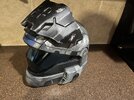
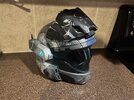
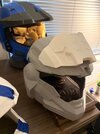
Here’s my current WIP (my two printed shells + top plate):


IMG_2003.jpeg

(No Sanding has been done. This is the raw print from my P2S Bambu Lab.)

I’m getting ready to glue the helmet together, start sanding, filler priming, and all the painting steps, so I figured this would be a good time to ask the community for wisdom before I accidentally learn the hard way. Trying to avoid COSTLY FAILURES.


Looking for Advice From the Vets


1. Assembly / Gluing


  • Any common mistakes do first-timers make when joining big helmet pieces?
  • Best internal reinforcement: epoxy, fiberglass, JB Weld, something else?

2. Sanding


  • Grit progression that works best for PLA?
  • Do spots people forget to sand until it’s too late?

3. Priming & Painting


  • Favorite filler primer for Reach helmets?
  • Tips for clean panel lines or masking?
  • Anything you wish someone had told you before painting your first piece?

4. Visor Tips


  • Best Noble Six/Commando visor approach for beginners?
    -Film-based tinting or liquid-based tinting?
  • Mirror-tint tricks or vacuum-forming advice?
    (I own a DT2 Vaquform machine)


Open to Any Rookie-Saving Tips


If there’s anything you ran into on your first build that you’d warn a newcomer about, I’m all ears. I’ll keep updating this thread with progress pics as I go.


Thank you so much for your attention and participation.
 

Attachments

  • IMG_2004.jpeg
    IMG_2004.jpeg
    2.2 MB · Views: 3
Hey everyone!
This is my first Halo build, and I wanted to start a thread to show my progress and also gather some advice before I move into the next stages.


Here’s my current WIP (my two printed shells + top plate):


View attachment 371018
(No Sanding has been done. This is the raw print from my P2S Bambu Lab.)

I’m getting ready to glue the helmet together, start sanding, filler priming, and all the painting steps, so I figured this would be a good time to ask the community for wisdom before I accidentally learn the hard way. Trying to avoid COSTLY FAILURES.


Looking for Advice From the Vets


1. Assembly / Gluing


  • Any common mistakes do first-timers make when joining big helmet pieces?
  • Best internal reinforcement: epoxy, fiberglass, JB Weld, something else?

2. Sanding


  • Grit progression that works best for PLA?
  • Do spots people forget to sand until it’s too late?

3. Priming & Painting


  • Favorite filler primer for Reach helmets?
  • Tips for clean panel lines or masking?
  • Anything you wish someone had told you before painting your first piece?

4. Visor Tips


  • Best Noble Six/Commando visor approach for beginners?
    -Film-based tinting or liquid-based tinting?
  • Mirror-tint tricks or vacuum-forming advice?
    (I own a DT2 Vaquform machine)


Open to Any Rookie-Saving Tips


If there’s anything you ran into on your first build that you’d warn a newcomer about, I’m all ears. I’ll keep updating this thread with progress pics as I go.


Thank you so much for your attention and participation.
Hey buddy! Awesome helmet, you have a great start for this. Clean print, and honestly I thought it was a resin cast haha.

Some tips in order with your questions:

1. Glue: USE. CLAMPS. Using clamps to keep your halves together while they cure. An alternative to using glue could also be soldering with a soldering iron. Admittedly, i have yet to try this method, but many swear by this method as it is by far the most secure way to bond two prints as it melts them together.

2. Sanding: I usually go from 120 to 220 to 400/600 to 1000. I kinda am a but relaxed with this step but consistency and determination will make your end product much better. If at all possible and in the budget, I would highly recommend an orbital sander.

3. Primer: Rustoleum filler primer all the way. This stuffs super cheap at walmart and home depot. Give it a good 2-3 light sprays, dont let it pool up and spray in light swipes about a foot away from the helmet. You want a good coat to actually FILL the lines, but not enough to actually cause the paint to run. From there, lightly sand in circles. Keep this up and keep going in circles until you have a smooth product. Also recommend using spot glazing putty or bondo autofiller for those really rough layer lines. Be warned, the spot glaze has a tendency to chip and expose its light red color on a finished prop if hit a little too hard (at least in my experience).

4 Painting: Its never over. A bad paint job cant ruin a print, just sand it off and prime again. I repainted my ODST helmet 2 times before I got to where it is now. Second, WEATHER IT. Use black and brown acrylic paints watered down, dab it off with paper towels, build it up in the crevices. This will make the difference between your helmet looking like something that comes from a factory, and something thats seen the battlefield.

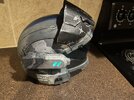
Good luck man! Im sure this will turn out awesome. I threw some photos of my helmet to hopefully illustrate some of the painting tips to ya bc sometimes text on a screen isnt enough lol.
 

Attachments

  • IMG_1475.jpeg
    IMG_1475.jpeg
    2.6 MB · Views: 3
  • IMG_1474.jpeg
    IMG_1474.jpeg
    3.1 MB · Views: 3
  • IMG_1476.jpeg
    IMG_1476.jpeg
    2.7 MB · Views: 3
Hey buddy! Awesome helmet, you have a great start for this. Clean print, and honestly I thought it was a resin cast haha.

Some tips in order with your questions:

1. Glue: USE. CLAMPS. Using clamps to keep your halves together while they cure. An alternative to using glue could also be soldering with a soldering iron. Admittedly, i have yet to try this method, but many swear by this method as it is by far the most secure way to bond two prints as it melts them together.

2. Sanding: I usually go from 120 to 220 to 400/600 to 1000. I kinda am a but relaxed with this step but consistency and determination will make your end product much better. If at all possible and in the budget, I would highly recommend an orbital sander.

3. Primer: Rustoleum filler primer all the way. This stuffs super cheap at walmart and home depot. Give it a good 2-3 light sprays, dont let it pool up and spray in light swipes about a foot away from the helmet. You want a good coat to actually FILL the lines, but not enough to actually cause the paint to run. From there, lightly sand in circles. Keep this up and keep going in circles until you have a smooth product. Also recommend using spot glazing putty or bondo autofiller for those really rough layer lines. Be warned, the spot glaze has a tendency to chip and expose its light red color on a finished prop if hit a little too hard (at least in my experience).

4 Painting: Its never over. A bad paint job cant ruin a print, just sand it off and prime again. I repainted my ODST helmet 2 times before I got to where it is now. Second, WEATHER IT. Use black and brown acrylic paints watered down, dab it off with paper towels, build it up in the crevices. This will make the difference between your helmet looking like something that comes from a factory, and something thats seen the battlefield.

Good luck man! Im sure this will turn out awesome. I threw some photos of my helmet to hopefully illustrate some of the painting tips to ya bc sometimes text on a screen isnt enough lol.
Thanks a lot for the insight, I really appreciate you taking the time to share it. Super helpful to hear from someone with experience!
 

Your message may be considered spam for the following reasons:

If you wish to reply despite these issues, check the box below before replying.
Be aware that malicious compliance may result in more severe penalties.
Back
Top